
Greetings everyone and I’m Scott Savoy at the Sterling Creations desk.
I hope that everyone is doing good.
Today our president shares a very personal editorial with her readers.
It is very much filled with her soul and her memories.
I encourage you to read and to send her your thoughts at donnajodhan@sterlingcreations.ca
Happy weekend.
+++++++++++++++
What Could The Better Future Be
By Donna J. Jodhan
What does a better future mean when someone we love is denied the opportunity to experience it?
In Loving Memory of My Nephew, Christian
September 30, 2026 — A Life Remembered
As I sit here writing this editorial in memory of my beloved nephew Christian, I find myself reflecting on a question that is both simple and profoundly difficult: What could the better future be?
On September 30, 2026, Christian lost his courageous battle with cancer. For more than two years, he fought the good fight, facing an unforgiving illness with a strength and determination that those who loved him will never forget.
And now he is gone.
Three words that are so easy to write, yet so terribly difficult to accept.
There is something profoundly heartbreaking about watching someone with so much to offer leave this world before his time. Christian was bright, kind, thoughtful, and full of ideas and suggestions. He had a mind that questioned, a heart that cared, and a spirit that deserved more time to experience all that life might have offered.
Yet life, as we are so often reminded, does not always unfold according to our hopes, our expectations, or even our prayers.
As someone who believes in life after life, I find myself wondering about Christian’s new journey. Where is he now? What does his future hold beyond the boundaries of this earthly existence?
I want to believe that he has entered a place where suffering no longer exists, where illness has no power, and where the limitations of the human body have given way to something far more beautiful.
Perhaps the better future for Christian is one we cannot see, one that lies beyond our understanding, beyond the reach of medicine, and beyond the uncertainty that defines so much of our lives.
Perhaps he has found the peace that this world could not give him.
But even as I hold on to that belief, another question continues to occupy my thoughts.
What might Christian’s future have been had he overcome cancer?
What dreams might he have pursued? What contributions might he have made? What conversations would we have shared? What new ideas, discoveries, or experiences might have shaped the years ahead?
Would he have found happiness in the simple pleasures of everyday living? Would he have travelled to places he had never seen, formed new friendships, or discovered passions that had yet to reveal themselves?
Would he have made a difference in someone’s life through an act of kindness, a thoughtful suggestion, or simply by being there when he was needed?
I suspect he would have done all these things and more.
And therein lies one of life’s greatest sorrows. When someone dies too soon, we grieve not only the person we have lost but also the future that will never be lived.
We mourn the birthdays that will never be celebrated, the family gatherings where an empty chair will remind us of an absence, and the countless ordinary moments that suddenly become extraordinary because they can no longer be shared.
We mourn the unfinished conversations, the laughter we will never hear again, and the simple comfort of knowing that someone we love is still somewhere in this world.
But Christian’s passing also causes me to reflect on something larger.
What kind of future are we creating for those who remain?
We live in a world filled with extraordinary possibilities, yet we seem equally determined to burden it with problems of our own making.
We have developed technologies that would have seemed miraculous only a generation ago. We can communicate across continents in seconds, explore the mysteries of the universe, and make medical discoveries that once belonged entirely to the realm of imagination.
And yet, despite these remarkable achievements, humanity continues to struggle with war, hatred, poverty, inequality, environmental uncertainty, and an alarming inability to live peacefully with one another.
We have become exceptionally skilled at advancing technology, but have we become equally skilled at advancing compassion?
We know how to build taller buildings, faster machines, and more powerful systems, but have we learned how to build a kinder world?
We spend enormous resources confronting one another, while diseases such as cancer continue to rob families of the people they love.
I cannot help but wonder what might be possible if humanity devoted as much energy to healing as it does to conflict, as much determination to understanding one another as it does to proving who is right, and as much creativity to preserving life as it does to competing for power.
Perhaps the better future is not simply about what we can invent, accumulate, or achieve.
Perhaps it is about what we can become.
A better future would be one in which fewer families must endure the anguish of watching a loved one struggle against a devastating illness.
It would be a future in which medical research continues to advance, where treatments become more effective and accessible, and where a cancer diagnosis no longer carries the fear and uncertainty that so many families know today.
It would be a world where kindness is not mistaken for weakness, where differences do not automatically become divisions, and where the value of a human life is measured not by wealth, status, or influence, but by the dignity inherent in every person.
It would be a future in which we remember that time is our most precious possession, precisely because none of us knows how much of it we have been given.
Christian’s life reminds me of that truth.
We often speak about the future as though it is something guaranteed, something waiting patiently for us just beyond tomorrow.
We make plans for next year, postpone conversations until another day, and assume that there will always be another opportunity to say what needs to be said.
But there are no guarantees.
Sometimes tomorrow arrives without someone we expected to be there.
And when that happens, our understanding of what truly matters changes forever.
The little disagreements that once seemed important lose their significance. The material things we pursue so relentlessly become less meaningful. And the moments we once took for granted become the memories we would give almost anything to experience again.
Christian’s passing has reminded me that a better future cannot be measured only in years.
It must also be measured in love, kindness, understanding, and the difference we make in the lives of others.
His time with us was far too short, but the value of a life is not determined solely by its length.
It is also found in the hearts it touches, the memories it creates, and the love it leaves behind.
Christian mattered.
His thoughts mattered. His kindness mattered. His presence mattered.
And although his earthly journey has ended, the meaning of his life does not end with it.
Those who knew him will carry something of him forward. A memory, a lesson, a smile, a conversation, or perhaps a renewed appreciation for the fragile and precious gift of life.
In that sense, Christian will continue to influence a future he will not be here to witness.
And perhaps that is one of the greatest responsibilities we have to those we lose.
We must try to make the world they leave behind a little better because they were here.
We cannot change what happened to Christian. We cannot give him back the years that cancer took from him. We cannot answer every question about why good people must sometimes endure such suffering.
But we can choose how we respond to his loss.
We can become more compassionate. We can be more generous with our time. We can support those who are suffering, encourage those searching for cures, and remember that behind every medical statistic is a human being with hopes, dreams, and people who love them.
We can choose understanding over indifference, kindness over cruelty, and hope over despair.
And we can remember to tell the people we love just how much they mean to us while we still have the opportunity.
As I reflect on Christian’s life, I find myself returning to the two futures that now occupy my thoughts.
The first is the future he might have experienced had cancer not intervened.
It is a future filled with unanswered questions, unrealized possibilities, and dreams that will forever remain beyond our reach.
The second is the future I believe he has entered.
It is a future I cannot describe with certainty, but one I choose to imagine as peaceful, beautiful, and free from the pain that marked the final years of his earthly life.
My faith allows me to hope that death is not the end of our existence, but rather a passage into something we do not yet fully understand.
And perhaps, one day, the questions that trouble us here will find their answers there.
Until then, we are left with our memories, our love, and the responsibility of making the most of the time we have been given.
So, what could the better future be?
For humanity, perhaps it is a world that finally learns to place compassion above conflict, healing above destruction, and the dignity of life above the pursuit of power.
For those of us who loved Christian, perhaps it is learning to live with his absence while ensuring that his memory remains a living part of who we are.
And for Christian himself, I hope the better future is one of endless peace, renewed wonder, and a happiness untouched by suffering.
I wish with all my heart that he could have stayed longer.
I wish he could have experienced more of the beauty this world still has to offer.
I wish we could have shared just one more conversation, one more laugh, one more ordinary day that we would now recognize as an extraordinary gift.
But wishes cannot change the past.
What they can do is remind us of what matters as we shape the future.
Christian’s journey on earth has ended, but his story continues in the lives of those who remember him.
And perhaps the greatest tribute we can offer him is not simply to mourn the future he was denied, but to work toward a better future for those who are still here.
A future with more hope.
More understanding.
More kindness.
And above all, more love.
Rest peacefully, Christian.
May the future you have entered be more beautiful than anything this world could ever have promised you.
And may those of us you leave behind find the wisdom and courage to make our own world worthy of the hopes and dreams you carried.
In loving memory of Christian, whose life was far too short, but whose place in our hearts will remain forever.
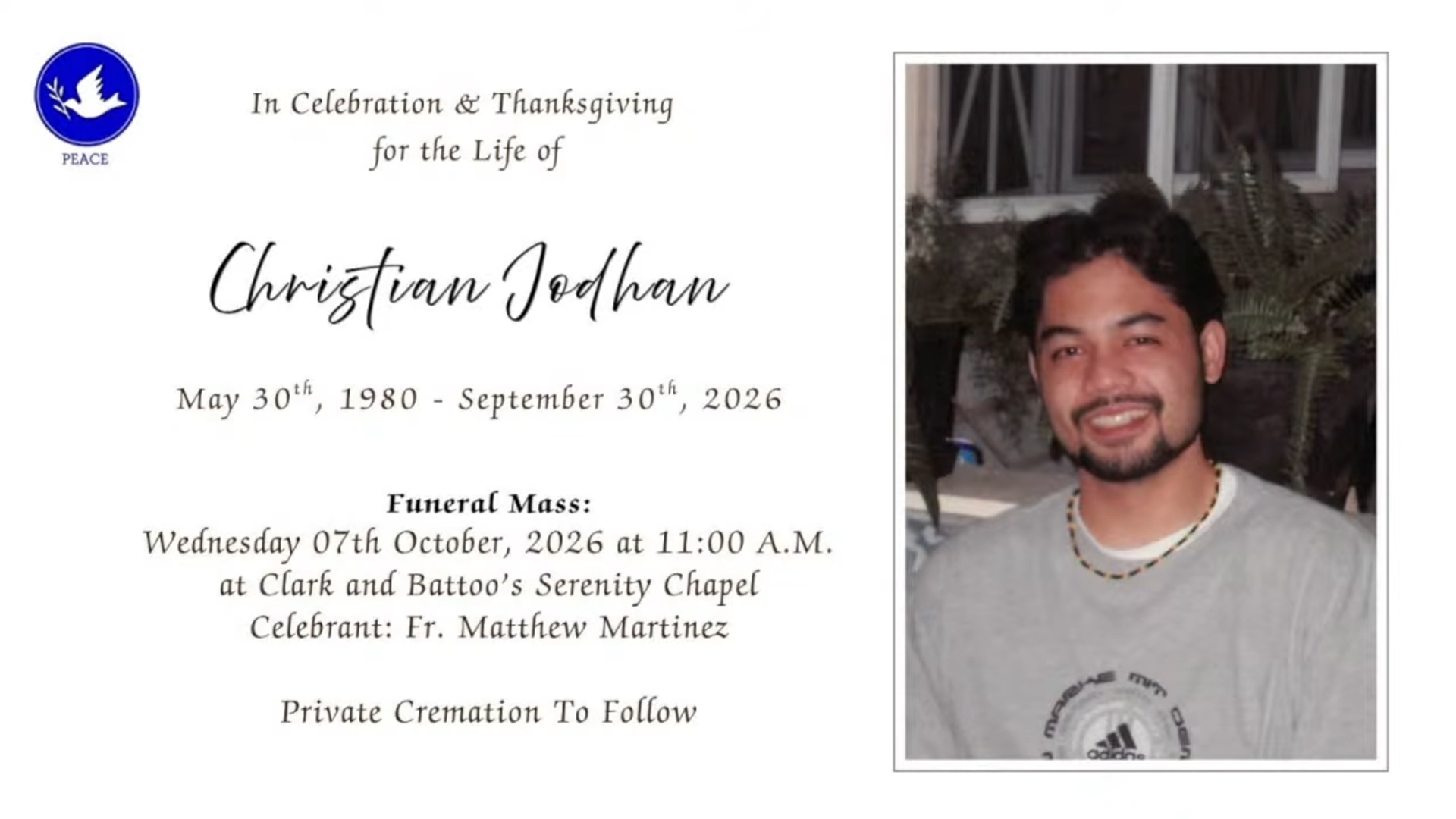
Image = Memorial card for Christian Jodhan. A circular blue logo with a white dove carrying an olive branch, labeled ‘PEACE,’ sits top left. Text reads: ‘In Celebration & Thanksgiving for the Life of Christian Jodhan, May 30th, 1980 – September 30th, 2026. Funeral Mass: Wednesday 07th October, 2026 at 11:00 A.M. at Clark and Battoo’s Serenity Chapel. Celebrant: Fr. Matthew Martinez. Private Cremation To Follow.’ On the right, a framed photo shows a smiling man with short dark hair and a goatee, wearing a gray Adidas T-shirt and a beaded necklace, in front of ferns and a window.
To learn more about me as an award winning sight loss coach and advocate visit http://www.donnajodhan.com